This is an old revision of the document!
Nintendo Entertainment System
The Nintendo Entertainment System, known as the Nintendo Famicon in Japan with a radically different design, is an 8-bit third-generation video game console released by Nintendo in Japan in 1983. It was redesigned as the NES and released two years later in the US, retailing for $179.99. Debatably the first majorly successful video game console after the North American video game crash of '83, probably why it looks more like a VCR than a console.
The original Famicom had the Family Computer Disk System add-on released for it which allowed playback of games on higher capacity discs which commonly featured enhanced sound capabilities. Since the NES had a delayed release, it included additional mapping hardware negating the need for the add-on, albeit without the sound enhancements. Many Famicom disk-only games were ported to cartridge form for their US release.
For emulation of Famicom disks specifically, use the fds folder instead.
Emulation of the NES is pretty well established. If your machine can only emulate one system at full speed, it will be this. Choice of emulator doesn't particularly matter, they're all good nowadays. MAME can emulate the Vs. Dualsystem cabinet, but if this your first time hearing about that don't worry about it.
| shortname | nes |
|---|---|
| emulator/core(s) | libretro/fceumm libretro/nestopia |
| rom format(s) | .nes .unif .unf .zip 7z |
Emulators
NES emulators will typically rely on the filename to choose the correct region setting and speed by default, Nestopia however uses a separate file, called Nstdatabase.xml, located in the userdata/bios folder.
libretro/fceumm
FCE Ultra “mappers modified” is a libretro-maintained fork of FCE Ultra. High compatibility. A small amount of early romhacks may only work in this emulator.
Configuration
| setting | description | recommendation |
|---|---|---|
| fceumm_nospritelimit | The NES has an 8 sprite limit per line, when this is exceeding the remaining sprites are flickered between (or sometimes just don't show up at all!) This setting removes that limit. | disabled Enabling it has no ill effect in most games but is less accurate to the original hardware. |
| nes.fceumm_palette |  <description> <description> | default <rec> |
| nes.fceumm_ntsc_filter | The emulator has the Blarg NTSC filter built-in, unrelated to the shader preset you can choose within Batocera. Values: False, composite, svideo, rgb. | Off You can use one of the presets inside Batocera instead. |
| nes.fceumm_sndquality | Sound quality. Low is good for most games, but those that run at lower clocks (like PAL games) sound terrible on this. High is good for everything. Very High is nearly cycle-accurate, but has substantially higher requirements than the other settings. If you're on at least a Pi 2 or higher this shouldn't matter. | Very High unless you are on exceptionally weak hardware like a Pi Zero. |
| nes.fceumm_overclocking | Overclocks the emulated PPU by adding dummy scanlines, giving the game more time to execute per frame. This can be used to avoid console slowdown, but some games encounter glitches with it on. 2x-Postrender applies the overclock before NMI. 2x-VBlank applies the overclock after NMI. | disabled Enabling can cause game crashing and save data corruption. If enabling, 2x-Postrender is preferred to 2x-VBlank. |
nes.controller1_nes | Choose what is plugged into port 1. 1 for autodetect, 513 for a NES gamepad and 258 for a NES Zapper (requires mouse). | 1 unless otherwise needed. |
nes.controller2_nes | Same as above in addition to 514 for the Arkanoid paddle. | 1 unless otherwise needed. |
libretro/nestopia
A fork of Nestopia, Nestopia Undead Edition is the bug-fixed revival of the emulator. High compatibility and accuracy.
Configuration
| setting | description | recommendation |
|---|---|---|
| nes.nestopia_nospritelimit | The NES has an 8 sprite limit per line, when this is exceeding the remaining sprites are flickered between (or sometimes just don't show up at all!) This setting removes that limit. | disabled Enabling it has no ill effect in most games but is less accurate to the original hardware. |
| nes.nestopia_palette | | consumer |
| nes.nestopia_blargg_ntsc_filter | The emulator has the Blarg NTSC filter built-in, unrelated to the shader preset you can choose within Batocera. Values: False, composite, svideo, rgb. | Off You can use one of the presets inside Batocera instead. |
| nes.nestopia_overclock | 1x or 2x | 1x |
| nes.nestopia_palette | automatic, ntsc, famicom | automatic |
ROMs
.nes for cartridges, .fds for Famicom discs. Although the emulators can emulate both NES cartridges and Famicom disks just fine, Batocera has the systems split up into two separate entries, nes for NES and fds for Famicom. Put your roms in their respective folders, and then if you want you can group the systems inside of EmulationStation so that they share a menu.
Famicom disks typically have two sides! If you encounter a static screen that starts with B then it's likely asking you to flip sides. The default shortcut for flipping sides is L1.
The ROMs are pretty easy to mod as well, just open them up in a tile editor and you'll see all the game/sprite data stored in 8×8 pixel tiles. Level layout changes typically require a specialized level editor program for that game (if there even is one).
Controls
The NES had many accessories, most of which cannot be configured inside of Batocera but can be configured in RetroArch's Quick Menu (Hotkey+South) > Inputs. This can be saved per game via Quick Menu > Overrides > Save Game Override.
Of the controllers Batocera supports configuring, the NES Zapper uses the current mouse cursor as input. This can be emulated using the Mayflash Dolphinbar with a Wiimote for a more authentic experience. Traditional Zappers cannot be supported with modern displays (they relied on reading phosphors burning in the CRT and cannot “see” modern LCD screens).
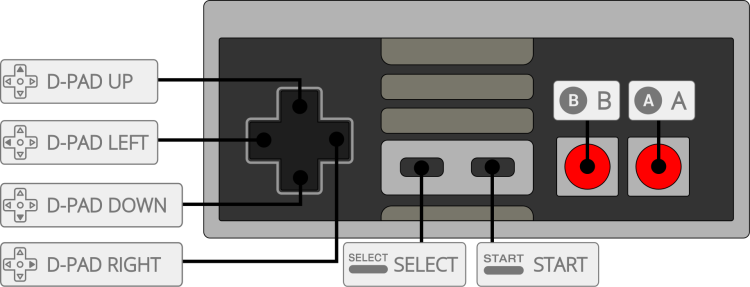
The default button mapping to the NES controller is as follows:
- systems/nes.1628068415.txt.gz
- Last modified: 5 years ago
- by atari