
Colour Genie
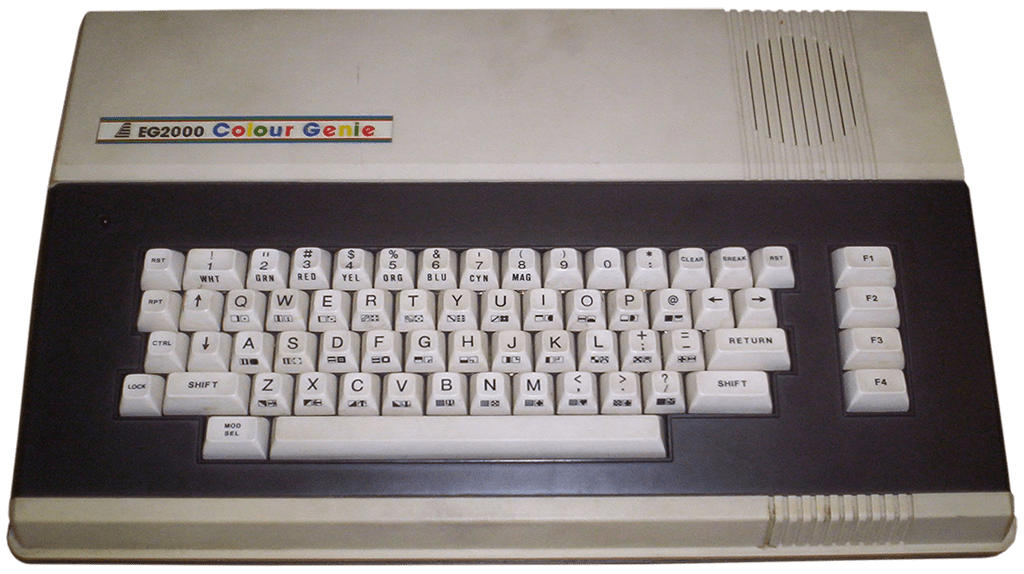
The Colour Genie EG2000 is a home computer produced by EACA (Engineering And Computer Applications), a Hong Kong-based electronics manufacturer. It was introduced in Germany in August 1982 and later distributed in the UK (at GBP 199 by Lowe Electronics), Australia, and New Zealand. EACA had previously produced the Video Genie series, which were largely TRS-80 Model I clones.
The Colour Genie features a Z80A CPU at 2.2 MHz, 16 KB RAM (expandable to 32 KB), 16 KB ROM containing Colour BASIC, a Motorola MC6845 CRTC with custom circuitry for video (160×96 pixels, 16 colors), and a General Instruments AY-3-8910 sound chip providing 3 tone channels plus a noise channel with programmable ADSR envelopes. It includes 128 user-definable characters, a 63-key keyboard, cassette tape interface, composite video, RF modulator, RS-232, light pen port, parallel printer port, and a cartridge/expansion slot.
While the Colour Genie's BASIC was broadly compatible with the Video Genie and TRS-80 Model III BASIC (minus the new graphics/sound commands), the hardware differences meant it could not directly run TRS-80 software. This was a critical disadvantage — previous Video Genie models had benefited from the enormous TRS-80 software ecosystem, but the Colour Genie lost this advantage, resulting in a limited dedicated software library.
The Colour Genie was a commercial failure due to software scarcity, fierce competition from the Commodore VIC-20, Dragon 32, ZX Spectrum, and Commodore 64, reliability issues (one dealer reported returning 75% of units), and ultimately EACA's bankruptcy.
This system scrapes metadata for the “cgenie” group(s) and loads the cgenie set from the currently selected theme, if available.
Quick reference
- Core: MAME, libretro: MAME
- Folder:
/userdata/roms/cgenie - Accepted ROM formats:
.cas,.wav,.zip,.7z
BIOS
| MD5 checksum | Share file path | Description |
|---|---|---|
bios/cgenie.zip | Colour Genie BIOS ROM set |
The cgenie.zip BIOS file must match the version of MAME used in your version of Batocera. You can verify your BIOS files from the Batocera menu: GAME SETTINGS > MISSING BIOS CHECK.
ROMs
Place your Colour Genie ROMs in /userdata/roms/cgenie.
Software was distributed primarily on cassette tapes. The supported file formats are:
.cas— cassette tape images.wav— raw cassette audio recordings
The Colour Genie's software library was limited due to its incompatibility with the TRS-80 ecosystem. Software had to be written specifically for the Colour Genie's unique graphics and sound capabilities.
Emulators
MAME
MAME (Multiple Arcade Machine Emulator) is the primary emulator for the Colour Genie in Batocera.
RetroArch
RetroArch (formerly SSNES), is a ubiquitous frontend that can run multiple “cores”, which are essentially the emulators themselves. The most common cores use the libretro API, so that's why cores run in RetroArch in Batocera are referred to as “libretro: (core name)”. RetroArch aims to unify the feature set of all libretro cores and offer a universal, familiar interface independent of platform.
RetroArch configuration
RetroArch offers a Quick Menu accessed by pressing [HOTKEY] +  which can be used to alter various things like RetroArch and core options, and controller mapping. Most RetroArch related settings can be altered from Batocera's EmulationStation.
libretro: MAME
The libretro version of MAME can be used to emulate the Colour Genie. It uses the same BIOS and ROM sets as the standalone version.
Controls
The Colour Genie is a computer system with a 63-key typewriter-style keyboard. A physical USB keyboard is strongly recommended.
See also
- TRS-80 — related but incompatible system; EACA's earlier Video Genie models were TRS-80 clones
- TRS-80 Color Computer (CoCo) — Tandy's own color computer
- ZX Spectrum — competing home computer from the same era
Troubleshooting
Black screen on boot
Make sure the BIOS file (cgenie.zip) is in /userdata/bios/ and matches the MAME version used in Batocera. Use GAME SETTINGS > MISSING BIOS CHECK to verify.
Further troubleshooting
For further troubleshooting, refer to the generic support pages.
- systems/cgenie.txt
- Last modified: 6 months ago
- by wizzard